
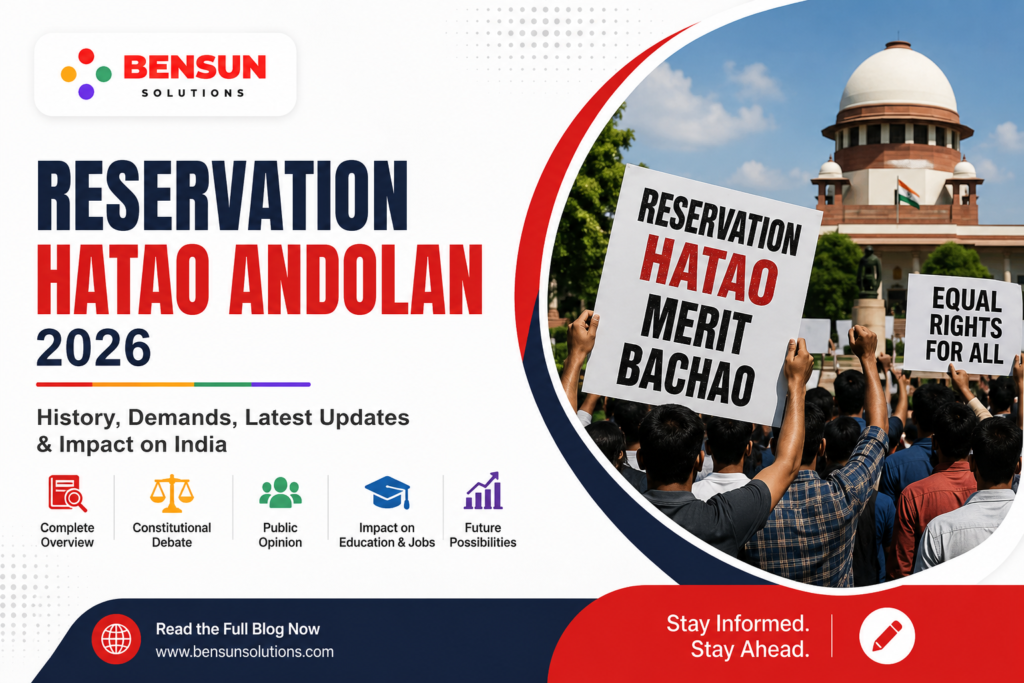
Reservation Hatao Andolan 2026: Complete Guide to History, Objectives, Latest Updates, Constitutional Debate, Public Opinion & Future Impact
Focus Keyword: Reservation Hatao Andolan
SEO Title: Reservation Hatao Andolan 2026: History, Demands, Latest News, Constitutional Debate & Impact
Meta Description: Discover everything about Reservation Hatao Andolan 2026, including its history, objectives, latest developments, constitutional provisions, public opinion, impact on students, government jobs, education, FAQs, and future possibilities.
Reservation Hatao Andolan 2026
The Reservation Hatao Andolan has emerged as one of the most debated social and political discussions in India. The movement has attracted attention from students, job aspirants, professionals, political organisations, social activists, and the general public. As conversations around equal opportunities, merit, social justice, and affirmative action continue, the issue remains at the centre of national debate.
The reservation system has existed in India for decades and was introduced to address historical discrimination and improve opportunities for disadvantaged communities. However, some individuals and organisations argue that the system should be reviewed or modified, while others believe it remains necessary to ensure social equality.
This article provides a comprehensive overview of the Reservation Hatao Andolan, its background, objectives, constitutional framework, arguments from different perspectives, potential impact, and frequently asked questions.
What is Reservation Hatao Andolan?
Reservation Hatao Andolan refers to a movement in which individuals or groups advocate for reviewing, reforming, or removing the existing reservation system in India. The movement generally promotes the idea that admissions to educational institutions and recruitment to government jobs should primarily be based on merit.
It is important to note that there is no single organisation or unified leadership representing every participant in the movement. Different groups may have different objectives, methods, and demands.
The movement has gained visibility through:
- Public rallies
- Peaceful demonstrations
- Social media campaigns
- Online discussions
- Public meetings
- Student participation
- Civil society debates
Understanding the Reservation System in India
To understand the Reservation Hatao Andolan, it is essential to understand why reservation was introduced.
India’s reservation system was established to improve educational, employment, and political opportunities for historically disadvantaged communities. It seeks to reduce long-standing social inequalities by providing reserved seats in educational institutions, government employment, and elected bodies.
Reservation primarily applies to:
- Government jobs
- Educational institutions
- Political representation
- Certain public sector recruitments
The system has evolved through constitutional amendments, government policies, and decisions of the judiciary.
History of Reservation in India
The concept of reservation has developed over many decades. Important milestones include:
Before Independence
Some princely states introduced measures to improve opportunities for disadvantaged communities before India became independent.
After Independence
The Constitution of India incorporated provisions allowing the State to make special arrangements for socially and educationally disadvantaged groups.
Expansion of Reservation
Over the years, reservation policies expanded through constitutional amendments, government decisions, and judicial interpretations.
Continuing Debate
As society and economic conditions have changed, discussions have continued regarding the scope, effectiveness, and future of reservation policies.
Objectives of Reservation Hatao Andolan
Although different organisations may have different viewpoints, common objectives often include:
- Greater emphasis on merit-based selection
- Review of existing reservation policies
- Equal competition for all candidates
- Greater use of economic criteria
- Periodic evaluation of reservation benefits
- Policy reforms based on current socio-economic conditions
Why Has Reservation Hatao Andolan Become Popular?
Several reasons have contributed to increased discussion:
1. Competitive Examinations
Many candidates preparing for government examinations discuss reservation policies because they affect recruitment processes.
2. Government Jobs
Limited vacancies often increase competition, leading to discussions about recruitment criteria.
3. Higher Education
Admission processes in universities and professional institutions have also become part of the debate.
4. Social Media
Platforms such as X, Facebook, Instagram, and YouTube have significantly increased public awareness and discussion.
5. Public Awareness
Young people today actively participate in policy discussions and constitutional debates.
Major Demands Raised by Supporters
Supporters of the movement commonly propose:
- Review of reservation policies
- Greater emphasis on merit
- Inclusion of economic criteria
- Time-bound evaluation of reservation
- Equal opportunities for every citizen
- Transparent recruitment systems
Different organisations may emphasise different priorities.
Arguments Presented by Supporters
Supporters generally argue that:
- Merit should play a larger role in admissions and employment.
- Reservation policies should be periodically reviewed.
- Economic disadvantage should receive greater consideration.
- Competition should be more uniform for all applicants.
These arguments are part of ongoing public debate.
Arguments Presented by Opponents
Opponents generally argue that:
- Reservation continues to address historical social inequalities.
- Many disadvantaged communities still face barriers in education and employment.
- Social justice remains an important constitutional objective.
- Representation in public institutions remains significant.
These perspectives are also widely represented in academic, legal, and public discussions.
Constitutional Framework
Reservation policies are supported by several provisions of the Constitution of India and have been interpreted through judicial decisions.
Any significant change to reservation policies would generally require constitutional, legislative, and judicial processes. Such changes cannot usually be implemented through public movements alone.
Reservation Hatao Andolan and Students
Students are among the most active participants in discussions surrounding reservation.
Key areas of concern include:
- University admissions
- Government recruitment
- Competitive examinations
- Equal opportunities
- Career planning
- Educational reforms
The movement has encouraged many students to learn more about constitutional provisions and public policy.
Impact on Government Job Aspirants
Government job aspirants closely follow discussions related to reservation because recruitment policies directly affect:
- Eligibility
- Selection procedures
- Competition levels
- Recruitment strategies
- Career planning
Any official policy change would depend on constitutional and legislative processes.
Impact on Education
Possible areas of discussion include:
- University admissions
- Technical education
- Medical education
- Engineering colleges
- Scholarships
- Professional institutions
Educational policies continue to evolve through government decisions and legal review.
Economic Perspective
Economists and policy experts often discuss whether affirmative action should rely solely on social criteria or also include economic conditions.
There are differing opinions, and no single approach has universal agreement.
Social Perspective
The Reservation Hatao Andolan has generated conversations about:
- Equality
- Merit
- Social justice
- Inclusion
- Representation
- Public policy
- Constitutional values
These discussions reflect the diversity of opinions within Indian society.
Political Perspective
Political parties and public representatives may hold differing views on reservation policy. Positions can change over time depending on legislative priorities, judicial decisions, and public opinion.
Public Opinion
Public opinion remains divided.
Some citizens believe:
- Merit should be prioritised.
- Reservation policies require periodic review.
- Economic conditions deserve greater consideration.
Others believe:
- Reservation continues to serve an important role in reducing historical inequalities.
- Equal representation remains necessary.
- Social justice objectives are still relevant.
Both viewpoints contribute to ongoing national discussions.
Latest Developments
The topic frequently trends on social media and appears in public debates, demonstrations, and news discussions. However, readers should rely on official government notifications, court judgments, and reputable news sources for verified updates, as developments can change over time.
Frequently Asked Questions (FAQs)
What is Reservation Hatao Andolan?
It is a movement advocating changes to or the removal of India’s reservation system, with many supporters favouring greater emphasis on merit-based opportunities.
Is Reservation Hatao Andolan an official government programme?
No. It is a public movement and not an official government scheme.
Can reservation be removed immediately?
No. Major changes would generally require constitutional, legislative, and judicial processes.
Why is the movement discussed widely?
It is linked to education, government employment, public policy, and constitutional debates, making it a widely discussed topic.
Does the movement represent everyone?
No. Different organisations and individuals involved may have different objectives and viewpoints.
Conclusion
The Reservation Hatao Andolan has become a prominent topic in discussions about education, employment, merit, equality, and social justice in India. While supporters advocate reviewing reservation policies and increasing the role of merit, others maintain that reservation remains an important tool for addressing historical inequalities and ensuring broader representation.
As the discussion continues, it is important to understand the constitutional framework, respect differing viewpoints, and rely on official announcements and verified information when evaluating developments. A balanced understanding helps readers engage thoughtfully with one of India’s most significant public policy debates.