
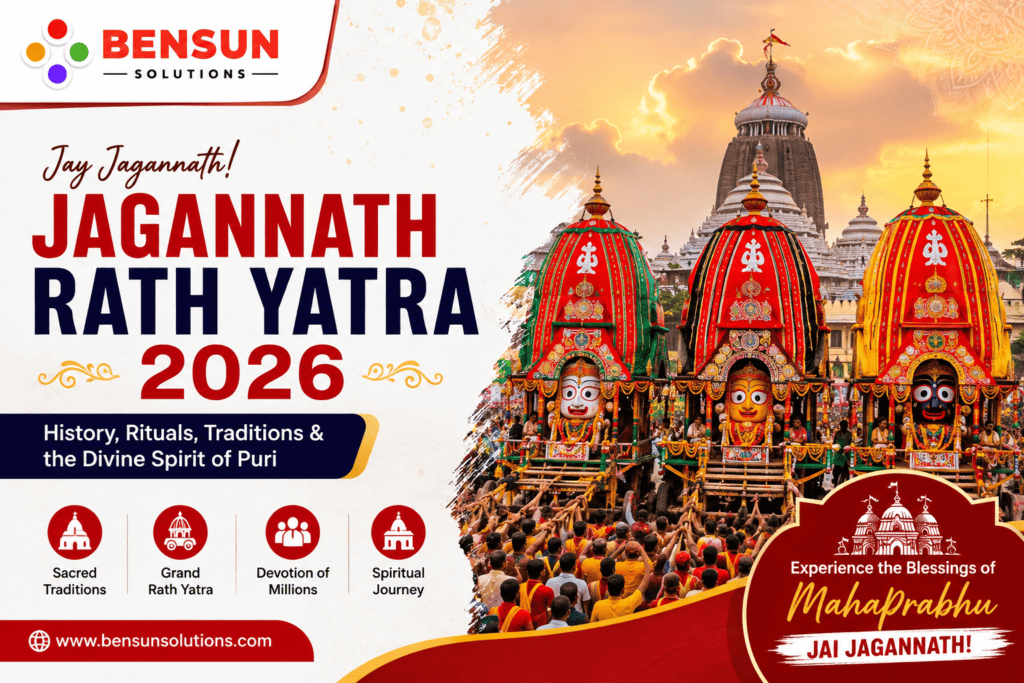
Jagannath Rath Yatra 2026: History, Rituals, Traditions & the Divine Spirit of Puri
Jay Jagannath!
Few celebrations in India can match the spiritual energy, devotion and cultural grandeur of the Jagannath Rath Yatra in Puri, Odisha. Every year, millions of devotees turn their hearts toward Puri to witness Lord Jagannath, Lord Balabhadra and Devi Subhadra leave the sanctum and begin their sacred journey on magnificent wooden chariots.
The Jagannath Rath Yatra 2026 was held in Puri on July 16, bringing huge crowds of devotees to the holy city. Despite heavy monsoon rain, lakhs of people gathered to experience the sacred procession and participate in the timeless tradition of pulling the chariots.
For devotees, Rath Yatra is not simply a festival. It represents faith, equality, devotion and the belief that Mahaprabhu Jagannath comes out to bless everyone.
What Is Jagannath Rath Yatra?
Jagannath Rath Yatra, also known as the Chariot Festival, is one of the most important annual festivals associated with Lord Jagannath of Puri.
During the festival, the deities of Lord Jagannath, Lord Balabhadra and Devi Subhadra are ceremonially brought out of the Jagannath Temple and placed on their enormous wooden chariots. The chariots then travel along Puri’s Grand Road toward the Gundicha Temple.
The annual Rath Yatra is closely connected with the traditions of the highly revered Jagannath Temple, a major pilgrimage destination in Odisha. Odisha Tourism describes Puri as one of the state’s important pilgrimage centres and highlights its famous annual Car Festival.
Why Is Jagannath Rath Yatra So Important?
The spiritual importance of Rath Yatra goes far beyond the spectacular chariots and enormous crowds.
One of the most meaningful aspects of the festival is that the deities leave the temple and come among the people. Devotees from different regions, communities and backgrounds gather together with the same prayer:
“Jai Jagannath.”
The festival therefore represents devotion, inclusiveness and the unique cultural identity of Odisha.
For many devotees, seeing the chariots and participating in the procession is considered a deeply emotional and spiritual experience.
The Three Chariots of Jagannath Rath Yatra
One of the most fascinating attractions of the Puri Rath Yatra is the construction and decoration of the three enormous chariots.
1. Nandighosha – Chariot of Lord Jagannath
The chariot of Lord Jagannath is known as Nandighosha.
It is traditionally constructed from wood and beautifully decorated for the annual journey. The massive chariot becomes the centre of attention as devotees pull it through the Grand Road.
2. Taladhwaja – Chariot of Lord Balabhadra
Lord Balabhadra travels in the Taladhwaja chariot.
Like the other chariots, it is constructed according to traditional practices and forms an essential part of the sacred procession.
3. Darpadalana – Chariot of Devi Subhadra
Devi Subhadra travels on the Darpadalana chariot.
The three chariots together create one of the most spectacular religious processions in India.
In preparation for the 2026 festival, hundreds of traditional artisans were involved in constructing the chariots, with hundreds of large wooden logs used for the three structures.
Important Rituals of Jagannath Rath Yatra
Rath Yatra is not a single ceremony. It is part of a series of important rituals and traditions.
Some of the best-known rituals associated with the festival include:
- Snana Purnima
- Anavasara period
- Netrotsava
- Pahandi
- Chhera Pahara
- Rath Yatra
- Gundicha Yatra
- Bahuda Yatra
- Suna Besha
- Niladri Bije
Each ritual has its own religious and cultural significance and forms part of the larger annual cycle of Jagannath traditions.
Pahandi: The Sacred Procession of the Deities
One of the most visually powerful moments of Rath Yatra is Pahandi.
During Pahandi, the deities are ceremonially brought from the temple toward their respective chariots.
Devotees gather to witness the procession while chanting the name of Lord Jagannath. In 2026, the Pahandi ritual marked the beginning of the grand procession as huge crowds gathered in Puri.
Chhera Pahara and Its Message of Equality
Another important tradition associated with Rath Yatra is Chhera Pahara.
During this ritual, the Gajapati Maharaja of Puri performs the symbolic sweeping of the chariots.
The ritual carries a powerful message: before Lord Jagannath, everyone is equal.
This simple but meaningful tradition is one of the reasons Jagannath culture has such a deep connection with the people of Odisha.
Journey to Gundicha Temple
After the sacred ceremonies, the three chariots travel along the Grand Road toward the Gundicha Temple.
The procession attracts enormous crowds, and devotees participate by pulling the massive chariots.
In 2026, the journey experienced a delay, and the chariots continued toward Gundicha Temple the following day as devotees returned to participate in the procession.
Why Millions of Devotees Visit Puri
Puri is one of India’s most important pilgrimage destinations.
The combination of the Jagannath Temple, sacred traditions, coastal atmosphere and annual Rath Yatra makes Puri a unique destination for pilgrims and visitors.
During Rath Yatra, the city experiences an extraordinary transformation. Streets become filled with devotees, religious chants, traditional music and the sight of enormous decorated chariots.
The scale of the festival also creates a significant travel demand. In 2026, Indian Railways announced more than 300 special trains for Rath Yatra travellers in addition to regular services.
The Cultural Importance of Lord Jagannath
Lord Jagannath is not only a central figure of Odisha’s religious life but also a powerful symbol of the state’s culture and identity.
The expression “Jai Jagannath” is recognised around the world and reflects the deep emotional connection devotees have with Mahaprabhu.
Jagannath culture can be experienced through temple traditions, festivals, music, art, food, architecture and the everyday lives of people across Odisha.
Jagannath Temple Puri
The Jagannath Temple in Puri is the spiritual centre of the Rath Yatra tradition.
The temple complex contains several shrines and important sacred structures and is one of Odisha’s most significant religious landmarks. Odisha Tourism describes the temple as a highly revered pilgrimage site associated with the annual Ratha Yatra.
For devotees, visiting Puri is about more than sightseeing. It is an opportunity to experience one of India’s most important living religious traditions.
The Spirit of “Jai Jagannath”
Perhaps the most powerful part of Rath Yatra is the sound of thousands of people chanting:
Jai Jagannath!
The words express devotion, hope and surrender.
Whether someone has visited Puri many times or is experiencing Jagannath culture for the first time, the atmosphere of Rath Yatra can leave a lasting impression.
Jagannath Rath Yatra and Modern India
Although the traditions of Jagannath are centuries old, Rath Yatra continues to attract enormous interest in the modern digital age.
Millions of people follow the festival through television, online news, social media, live videos and digital platforms.
This has allowed people who cannot travel to Puri to experience glimpses of the festival from their homes.
However, devotees should always verify viral photographs, videos and claims before sharing them online. During the 2026 festival, at least one widely circulated video claiming to show a drone display over the Jagannath Temple was found to be AI-generated.
Why Jagannath Rath Yatra Is More Than a Festival
Jagannath Rath Yatra brings together spirituality, tradition, craftsmanship, architecture, history and community.
From the traditional artisans who construct the giant chariots to the devotees who travel thousands of kilometres to Puri, every part of the celebration reflects a powerful connection with Lord Jagannath.
The festival also demonstrates how an ancient tradition can continue to remain meaningful to new generations.
Final Thoughts
The Jagannath Rath Yatra is one of India’s most extraordinary cultural and spiritual celebrations.
The magnificent chariots, sacred rituals, devotion of millions of people and powerful traditions make Puri a unique destination for anyone interested in India’s spiritual and cultural heritage.
The true beauty of Jagannath culture lies not only in the grandeur of the Rath Yatra but also in its message of faith, equality, devotion and humanity.
For devotees, the journey ultimately comes down to one heartfelt call:
Jai Jagannath.
May the blessings of Mahaprabhu Jagannath bring peace, happiness and prosperity to everyone.
Jai Jagannath! 🙏
Frequently Asked Questions
When was Jagannath Rath Yatra 2026 held?
The main Jagannath Rath Yatra in Puri was held on July 16, 2026.
Where is Jagannath Rath Yatra celebrated?
The most famous Jagannath Rath Yatra is celebrated in Puri, Odisha, beginning from the Jagannath Temple and proceeding toward Gundicha Temple.
Who travels on the three chariots?
Lord Jagannath, Lord Balabhadra and Devi Subhadra travel on their respective chariots during Rath Yatra.
What is the meaning of Jai Jagannath?
“Jai Jagannath” is an expression of devotion and reverence toward Lord Jagannath.
Why is Puri famous?
Puri is famous for the Jagannath Temple, Rath Yatra, religious traditions, cultural heritage and its importance as a major pilgrimage destination in Odisha.