
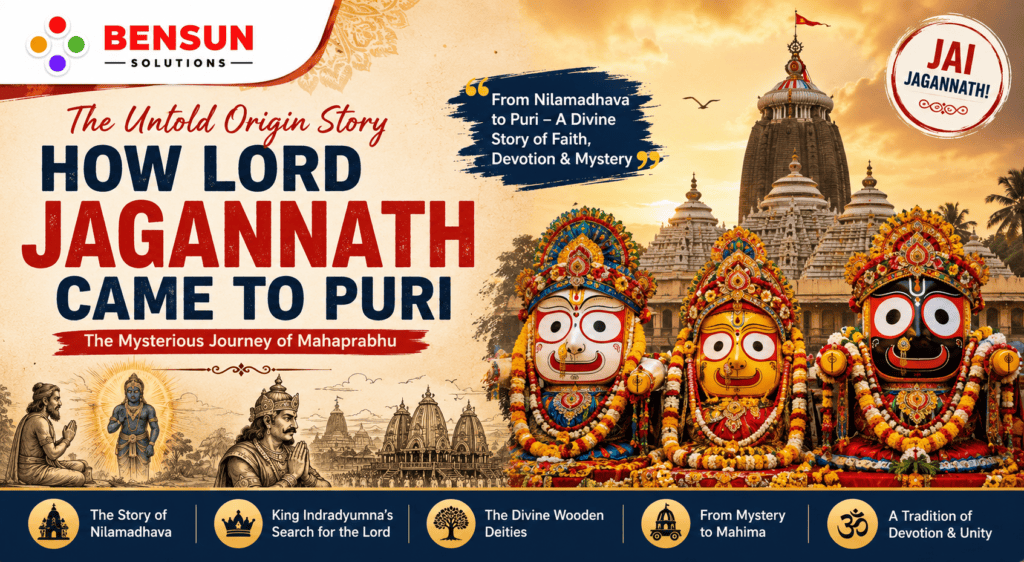
How Lord Jagannath Came to Puri: The Mysterious Origin Story of Mahaprabhu
Jai Jagannath! 🙏
Who is Lord Jagannath?
Where did Jagannath Mahaprabhu come from?
Why does Lord Jagannath have such a unique form?
And perhaps the biggest question of all—how did Lord Jagannath come to Puri?
For centuries, devotees have passed down fascinating stories about the origin of Lord Jagannath, the sacred deity of Puri, Odisha. The story connects kings, tribal traditions, devotion, divine mystery and one of India’s most remarkable pilgrimage traditions.
Today, the Jagannath Temple in Puri is one of Odisha’s most important religious landmarks. Odisha Tourism describes the present temple as dating to the 12th century and notes its extraordinary feature: the holy trinity of Jagannath, Balabhadra and Subhadra are represented through wooden deities rather than the stone or metal images commonly found in many temples.
But the story of Jagannath begins much deeper in tradition.
Who Is Lord Jagannath?
The name Jagannath is commonly understood as “Lord of the Universe.”
In Puri, Lord Jagannath is worshipped together with his elder brother Lord Balabhadra and sister Devi Subhadra.
Together, they are known as the Holy Trinity of Puri.
Their distinctive appearance, rituals and festivals have made the Jagannath tradition unlike almost any other major Hindu pilgrimage tradition.
Every year, millions of devotees are drawn to Puri for the famous Rath Yatra, when the deities leave the temple and travel on their magnificent chariots.
Odisha Tourism describes Rath Yatra as an annual festival in which Lord Jagannath and his siblings come out to meet devotees, regardless of caste, creed or community.
But before the grand chariots of Puri, there is another story—the story of Nilamadhava.
The Story of Nilamadhava: Before Jagannath Came to Puri
According to traditional Jagannath legends, the story begins with a mysterious deity known as Nilamadhava.
Nilamadhava was believed to be worshipped secretly by Vishwavasu, traditionally described as a tribal devotee.
The story tells of a hidden sacred deity worshipped deep within a forest.
The news of this mysterious divine form eventually reached King Indradyumna, a powerful and deeply devoted king.
The king became determined to find Nilamadhava.
He wanted to see the deity with his own eyes and establish a great temple where the Lord could be worshipped by everyone.
This search became one of the most famous episodes in the traditional origin story of Jagannath.
King Indradyumna’s Search for the Divine
King Indradyumna sent people in different directions to search for Nilamadhava.
One of the important figures in the traditional story is Vidyapati, who eventually learned about the hidden place where Nilamadhava was worshipped.
According to the legend, Vidyapati was taken toward the sacred location but the exact path was kept secret.
The story then takes a mysterious turn.
Vidyapati eventually discovered the sacred deity, but when the king came to see Nilamadhava, the deity was no longer there.
The divine form had disappeared.
For King Indradyumna, this was not the end.
It became the beginning of something much greater.
The Mysterious Disappearance of Nilamadhava
The disappearance of Nilamadhava is one of the most fascinating parts of the traditional Jagannath story.
The king was heartbroken.
He had searched for the deity, but the sacred form could no longer be found.
According to the traditional account, the king continued his devotion and received divine guidance.
The story says that Lord Jagannath would eventually manifest in another form.
This is where the legend of the mysterious wooden form of Jagannath begins.
How Did Lord Jagannath Appear?
According to the traditional story, a sacred piece of wood known as Daru appeared.
The king was instructed to use the divine wood to create the sacred forms.
However, there was an unusual condition.
A mysterious divine craftsman agreed to create the deities but asked to work privately without interruption.
The king accepted.
The doors were closed.
Days passed.
No one could see what was happening inside.
The king and everyone around him could only wait.
Then came the moment of doubt.
Why Do Jagannath, Balabhadra and Subhadra Have Unfinished Forms?
This is one of the most frequently searched questions about Lord Jagannath.
Why do the Jagannath idols look different from traditional Hindu idols?
Why are their hands and feet not fully formed?
The traditional legend provides a fascinating answer.
As the mysterious craftsman worked inside the room, the king became anxious because he could no longer hear the sounds of construction.
Unable to control his curiosity, he opened the door before the work was completed.
According to the legend, the divine craftsman had disappeared.
The three sacred forms remained in their distinctive unfinished appearance.
These became the forms of:
Lord Jagannath
Lord Balabhadra
Devi Subhadra
Rather than seeing the unusual forms as incomplete, devotees understand them as a unique manifestation of the divine.
The wooden form itself is one of the distinctive features of the Jagannath tradition. Odisha Tourism specifically notes that the holy trinity is carved from wood and describes them as having an unusual relationship with mortality compared with conventional stone or metal temple images.
Why Is Lord Jagannath Made of Wood?
This is one of the biggest mysteries surrounding Jagannath.
Unlike many major Hindu temple traditions where deities are commonly represented in stone or metal, the sacred forms at Puri are made of wood.
The tradition is connected with the concept of Nabakalebara, the ceremonial renewal of the wooden bodies of the deities.
The word is associated with receiving a “new body.”
The old wooden forms are ceremonially replaced according to traditional rituals, while the sacred essence is transferred according to the temple tradition.
This makes the Jagannath tradition particularly unique.
Is the Jagannath Origin Story History or Mythology?
This is an important distinction.
The story of Nilamadhava, Vishwavasu, Vidyapati and King Indradyumna belongs to the traditional religious and mythological narratives surrounding Lord Jagannath.
It should not be presented as a historically proven sequence of events.
At the same time, the Jagannath tradition itself has a deep historical presence in Odisha.
The present Jagannath Temple in Puri is associated with the 12th century, according to Odisha Tourism. The temple later received additions and developments over subsequent centuries.
Therefore, the best way to understand Jagannath is to look at both sides:
Faith and tradition explain the sacred origin story.
History and archaeology help us understand the development of the temple and Jagannath tradition through time.
How Did Jagannath Become the Lord of Puri?
Over generations, Puri became the great centre of Jagannath worship.
The temple became the spiritual heart of the city.
Devotees from Odisha and beyond began travelling to Puri to receive darshan of Mahaprabhu.
The Jagannath tradition eventually became deeply connected with Odisha’s identity.
Odisha Tourism itself describes Odisha as the land of Lord Jagannath and identifies the Puri temple as the centre of the Jagannath tradition.
Why Is Puri So Important to Jagannath?
Puri is not simply a city with a famous temple.
For devotees, it is Jagannath Dham.
The city is closely connected with the religious, cultural and spiritual traditions of Lord Jagannath.
The Puri temple is also traditionally regarded as one of India’s four major pilgrimage centres, the Char Dham.
This makes Puri one of India’s most important pilgrimage destinations.
The Mystery Behind the Jagannath Form
The distinctive appearance of Jagannath, Balabhadra and Subhadra has fascinated devotees and visitors for generations.
Their large round eyes, colourful forms and unusual proportions make them immediately recognisable.
But for devotees, the form is not simply an artistic design.
It represents a divine manifestation deeply rooted in the religious tradition of Odisha.
The uniqueness of the idols is one reason the Jagannath tradition continues to attract enormous interest from pilgrims, historians, artists and travellers.
From the Temple to the Streets: Rath Yatra
The story of Jagannath does not remain inside the temple.
Every year, Mahaprabhu comes out to meet his devotees during Rath Yatra.
The three deities travel on their enormous chariots through the streets of Puri.
This is why Rath Yatra is often described as the festival where the Lord comes out to meet the people.
Odisha Tourism calls Ratha Jatra the state’s biggest festival in terms of following and describes it as a symbol of universal brotherhood.
The Three Sacred Chariots
During Rath Yatra, the three deities travel on separate chariots.
Nandighosha
The magnificent chariot of Lord Jagannath is known as Nandighosha.
Taladhwaja
Lord Balabhadra travels on Taladhwaja.
Darpadalana
Devi Subhadra travels on Darpadalana.
The sight of the three enormous chariots moving through Puri is one of India’s most recognisable religious spectacles.
The Message of Jagannath
Perhaps the most powerful aspect of Jagannath culture is its message.
During Rath Yatra, the Lord comes outside the temple and meets people.
The festival brings enormous numbers of devotees together.
The traditional Chhera Pahara ritual carries an especially powerful message of equality: the Gajapati king symbolically sweeps the chariots, demonstrating humility before the Lord. Odisha Tourism describes the ritual as conveying that everyone is equal before Jagannath.
This is one reason Jagannath is not merely a deity associated with a temple.
For millions of people, Jagannath is a living cultural and spiritual tradition.
Why Do People Say “Jai Jagannath”?
“Jai Jagannath” is more than a greeting.
It is an expression of devotion.
It can represent faith, hope, gratitude and surrender.
Across Odisha and among Jagannath devotees around the world, the words continue to carry enormous emotional meaning.
Jai Jagannath!
The Eternal Journey of Mahaprabhu
The story of Lord Jagannath is a fascinating combination of faith, mythology, history and culture.
From the mysterious story of Nilamadhava to King Indradyumna, from the sacred Daru to the unique wooden forms, and from the quiet sanctum of the temple to the enormous crowds of Rath Yatra, every part of the Jagannath tradition carries its own story.
The greatest mystery may not be how the Lord came to Puri.
Perhaps the greater mystery is how a centuries-old tradition continues to inspire millions of people today.
The temple stands in Puri.
The Rath Yatra fills the streets.
The chariots move forward.
And devotees continue to call out:
JAI JAGANNATH! 🙏
Frequently Asked Questions About Lord Jagannath
Who is Lord Jagannath?
Lord Jagannath is the principal deity worshipped at the Jagannath Temple in Puri, Odisha. He is worshipped alongside Lord Balabhadra and Devi Subhadra.
What does Jagannath mean?
Jagannath is commonly interpreted as “Lord of the Universe.”
How did Lord Jagannath come to Puri?
According to traditional Jagannath legends, the story is connected with the mysterious deity Nilamadhava, King Indradyumna, Vishwavasu and the divine manifestation of the wooden forms of Jagannath, Balabhadra and Subhadra.
Who was King Indradyumna?
King Indradyumna is a central figure in traditional Jagannath origin narratives and is associated with the establishment of worship of Lord Jagannath at Puri.
Why are Jagannath idols made of wood?
The Jagannath tradition uniquely uses wooden forms for the Holy Trinity. The tradition also includes the ceremonial renewal of the wooden bodies through Nabakalebara.
Why does Lord Jagannath have big round eyes?
The distinctive form of Jagannath is part of the traditional sacred representation of the deity. The unusual form is one of the defining characteristics of Jagannath worship.
Where is Lord Jagannath’s temple?
The famous Jagannath Temple is located in Puri, Odisha, India.
Why is Puri famous?
Puri is famous for the Jagannath Temple, Rath Yatra, pilgrimage traditions, cultural heritage and its importance as one of India’s major sacred destinations.
What is Rath Yatra?
Rath Yatra is the annual chariot festival during which Lord Jagannath, Lord Balabhadra and Devi Subhadra leave the temple and travel on their decorated chariots.
What does “Jai Jagannath” mean?
“Jai Jagannath” is a devotional expression meaning victory/glory to Lord Jagannath.
Final Message
The story of Jagannath is not simply a story about the beginning of a temple.
It is a story about faith, devotion, mystery, culture and the eternal relationship between the Lord and his devotees.
From Nilamadhava to Mahaprabhu Jagannath, from the sacred wood to the magnificent Rath Yatra, the journey continues.
Jai Jagannath. 🙏
May Mahaprabhu bless everyone with peace, happiness and prosperity.